 10R-EA
Runway Incursion Mitigation (RIM) Program and Related Improvements Project at Boise Airport
FINAL ENVIRONMENTAL ASSESSMENT AND FEDERAL FINDING OF NO SIGNIFICANT IMPACT/RECORD OF DECISION
The Federal Aviation Administration (FAA) accepted the Final Environmental Assessment (EA) for the Runway Incursion Mitigation and Related Improvements Project at Boise Airport, Boise, Idaho as a federal document and based its June 2026 Finding of No Significant Impact/Record of Decision (FONSI/ROD) on that Final EA. The FONSI/ROD and Final EA are available to the public pursuant to the National Environmental Policy Act (NEPA).
The FONSI/ROD and EA are available for review for 30 days beginning June 18, 2026, during normal business hours at the Boise Airport Administration Offices, 3201 Airport Way, Suite 1000, Boise, Idaho 83705 and online on this webpage.
Final Environmental Assessment:
- Notice of Final EA Availability and Public Workshop
- Final Environmental Assessment FONSI-ROD
- Final Environmental Assessment
- Appendix A - Acronyms and Abbreviations
- Appendix B - Airport Information and Background
- Appendix C - Alternatives
- Appendix D - Aviation Emissions and Air Quality
- Appendix E - Biological Resources
- Appendix F - Historic and Cultural Resources
- Appendix G - Land Use
- Appendix H - Forecast Memo
- Appendix I - Noise and Noise-Compatible Land Use
- Appendix J - Socioeconomics and Children's Environmental Health and Safety Risks
- Appendix K - Water Resources
- Appendix L - Agency Coordination and Public Outreach
- Appendix M - References
- Appendix N - List of Preparers
Draft Environmental Assessment:
- Notice of Draft EA Availability and Public Workshop
- Draft Environmental Assessment
- Appendix A - Acronyms and Abbreviations
- Appendix B - Airport Information and Background
- Appendix C - Alternatives
- Appendix D - Aviation Emissions and Air Quality
- Appendix E - Biological Resources
- Appendix F - Historic and Cultural Resources
- Appendix G - Land Use
- Appendix H - Forecast Memo
- Appendix I - Noise and Noise-Compatible Land Use
- Appendix J - Socioeconomics and Children's Environmental Health and Safety Risks
- Appendix K - Water Resources
- Appendix L - Agency Coordination and Public Outreach
- Appendix M - References
- Appendix N - List of Preparers

What runway changes are included in the project?
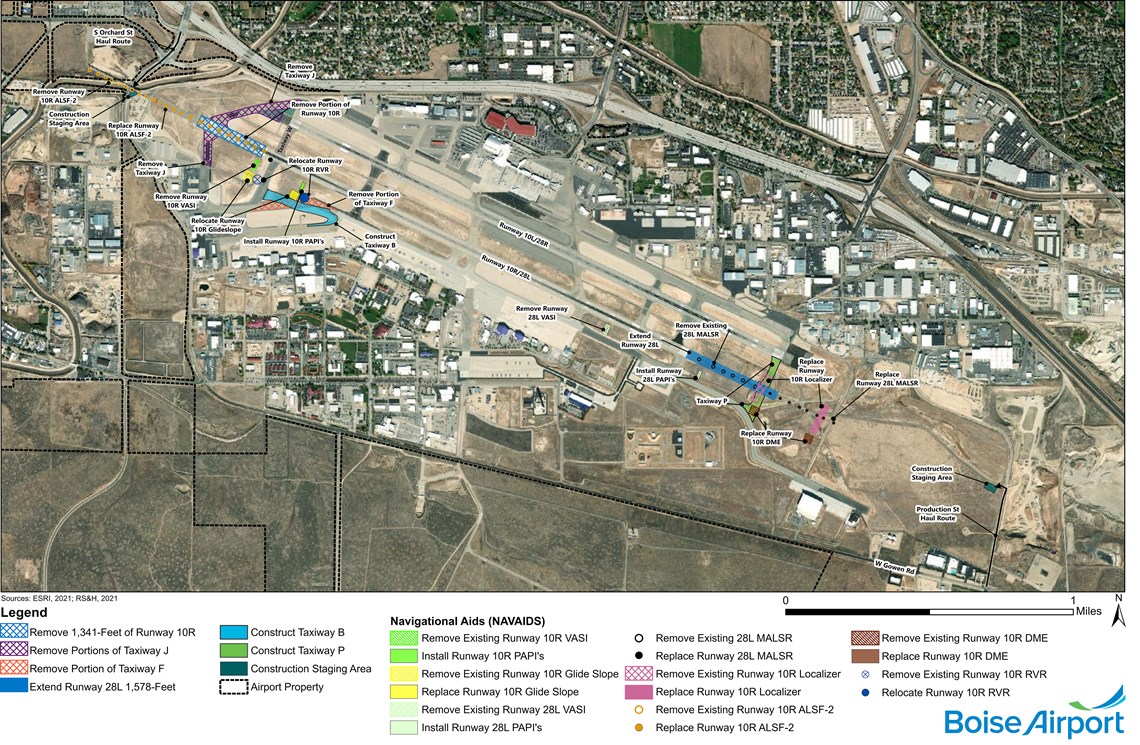
- Extending Runway 28L by 1,578 feet for a total new runway length for Runway 10R/28L of 10,000 feet. This would be achieved between a combination of relocating 1,341 feet from Runway 10R to 28L and adding an additional 237 feet.
- Relocating and/or replacing navigational aids (NAVAIDs), physical devices on the ground for aircraft pilots to detect and fly to. NAVAIDs include Distance Measuring Equipment (DME), Localizer (LOC), Approach Lighting System with Sequenced Flashing Lights (ALSF-2), Visual Approach Slope Indicator (VASI), Precision Approach Path Indicators (PAPIs), Glideslope, Runway Visual Range (RVR), Medium Intensity Approach Lighting System with Runway Alignment Indicator Lights (MALSR).
- Removing portions of Taxiways J and F.
- Constructing Taxiways B and P.
What is a Runway Incursion Mitigation (RIM)?
Runway incursions occur when the airfield geometry is such that there is risk of aircraft or vehicles in a protected area reserved for aircraft landing or taking off. Risk factors that contribute to runway incursions may include unclear taxiway markings, airport signage, and more complex issues such as the runway or taxiway layout. RIM improvements look to reconfigure runways and taxiways with simpler geometry and remove hot spots, locations on an airport movement area with a history or potential risk of collision or runway incursion.
Why is the Boise Airport proposing RIM improvements?
During the 2019 Boise Airport Master Plan Update, a hot spot and nonstandard taxiway geometry were identified as contributing to the increased risk of runway incursions. The Federal Aviation Administration (FAA) included the Boise Airport in its official RIM program in 2018 to begin the process for mitigating those risks. Additionally, a Runway Safety Action Team for the Airport identified the Airport’s staggered runway thresholds as a potential contributor for wrong surface landings.